I Tried BMAD on a Real Feature
Adopt, Adapt, Skip — If You Were Starting on Monday

Note: Originally published on Medium
At the end of The Living Specification, I wrote that structured methods for AI-driven development deserved their own article, and that BMAD was one of the notable approaches I had come across.
This is that article.
And before diving into the topic, the question we should ask is not "Is BMAD good?" It is simpler than that: "What does BMAD add when you already have a specification that is the source of truth?"
I ran BMAD with the Superpowers plugin for Claude Code on a real feature, across two repositories: a Java backend and an Angular frontend. What follows is what I learned, including where I got wrong. The purpose of this article is to share my reasoning about where it is useful to use BMAD and where we should absolutely avoid it.
Over two months of AI-assisted work, the single most expensive habit I had to break was letting the specification live in several places at once: a bit in the ticket, a bit in the architecture document, a bit in a chat I could no longer find, and a bit in the code itself. A human team survives that, people ask each other. An AI does not ask. It reads whatever you point it at, treats it as the truth, and writes hundreds of consistent lines on top of a fragment.
A specification scattered across five places is not a specification. It is five opinions, and the AI will pick one: not necessarily the right one, just the one it happened to read.
So the rule that runs through this entire article is the same: one shared place holds the intent; everything else refers to it. That sounds obvious until you add a formal method on top of an existing one, because a method arrives with its own artifacts, and every one of them wants to be the source of truth too.
If you have not read the series
The method I am comparing against is simple to state: the specification is the source of truth, the invariants are the contract, and the code is an implementation of that contract. Work state lives in plan files, not in conversations. "Done" means a verification command and its real output, not "it should work". The human owns the commit.
The story behind it is in Part 1, and the method itself in Part 2.
What BMAD actually is
BMAD is, simply, files. It is a collection of agent personas and workflows written in Markdown, plus a CLI installer that drops them into your AI coding tool. It is not a product, an IDE, or a service you log into.
That matters more than it sounds. Because BMAD lives as text in your repository, it is portable across Claude Code, Cursor, Kiro, or others.
The BMad Method module organises work into four phases: Analysis (optional), Planning, Solutioning, and Implementation. Each phase produces documents that become the context for the next one. The official framing is explicit about the reason for this: without that structure, agents make inconsistent decisions.
Each phase offers several workflows rather than a single mandatory path. Planning has bmad-prd and bmad-spec. Solutioning has bmad-architecture, bmad-create-epics-and-stories and bmad-sprint-planning. Implementation converges on bmad-build, with bmad-code-review, bmad-correct-course and bmad-retrospective around it.
Do not memorise those names. BMAD moves quickly so take the list as an illustration of the shape.
Whatever the names are in your version, you are meant to choose among them rather than run them all. That is the part most people miss, and it is the reason BMAD gets a reputation for heaviness that it doesn't always deserve.
So why BMAD, and not a template of my own?
If BMAD is just files, why I did not write my own? I already had rules, skills, and reusable prompts. So, just adding an epic template and an architecture template would have taken an afternoon.
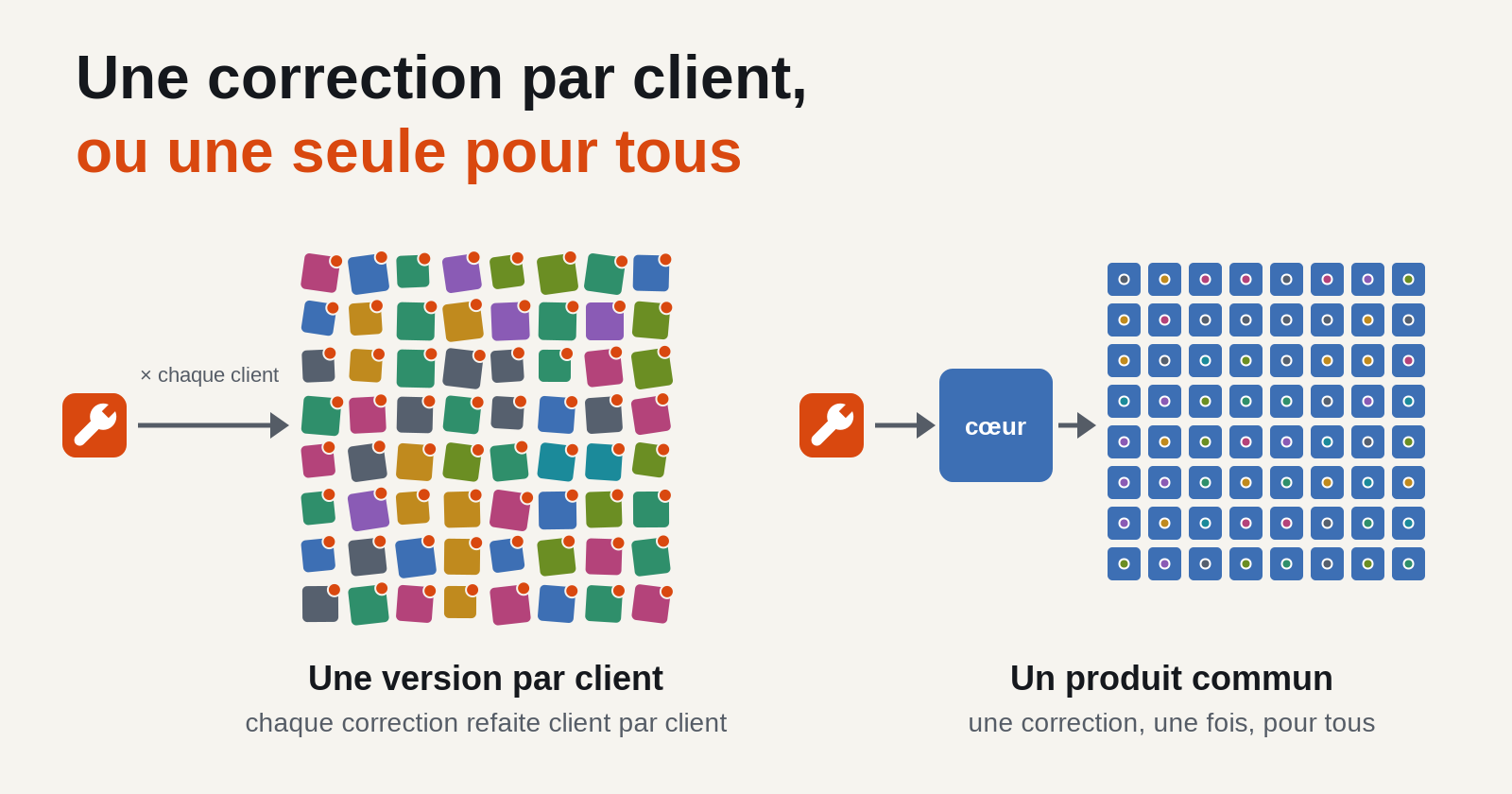
The first answer is that a template and a method are not the same thing. A template gives you a shape to fill in. BMAD gives you a process that questions you while you fill it in: guided discovery instead of an empty heading. My own templates ask the questions I already know to ask. They do not challenge the blind spots I don't know I have. It is the same reason the adversarial review in Part 1 beat my own review: not more knowledge, but a different angle of attack.
The second part is the ordering and the handoffs: which artifact must exist before which one, and what each step is allowed to assume. That is the part I would have got wrong alone, and the part that took the longest to learn.
And the third part is the one I didn't expect to matter so much. I adopted BMAD, I did not copy it into my project. It stays what it is, upstream, and it improves without me. If I had written my own version, every improvement would have been mine to invent and mine to maintain.
Adopting it costs less than people assume because BMAD does not ask you to change tools. That is what makes it feel more like an engine you can share than a framework you install: the method is common, the tooling stays yours. That argument has a longer version, and I come back to it at the end of this article.
How I used it
This came after two months of delivering features for the same product. I was then asked to build a few dashboards. However, this article focuses on the first one, because it took most of the time.
The feature was an income & expenses dashboard, with trends, period comparisons, and other details that aren’t relevant here. As I analysed it, I found myself duplicating invariants and rules across both repositories again, not for the first time in this project, and not without knowing better. But this feature was large enough that the duplication would not stay small. I needed a method that would stop it at the source.
And as I was using the Superpowers plugin and didn't want to lose it, I created a whole loop combining it with BMAD to benefit from both.
My loop, shown in the figure below, has three stages. Only the first and last are BMAD, and they sit a layer above its four phases rather than renaming them: Stage 1 alone runs through more than one.
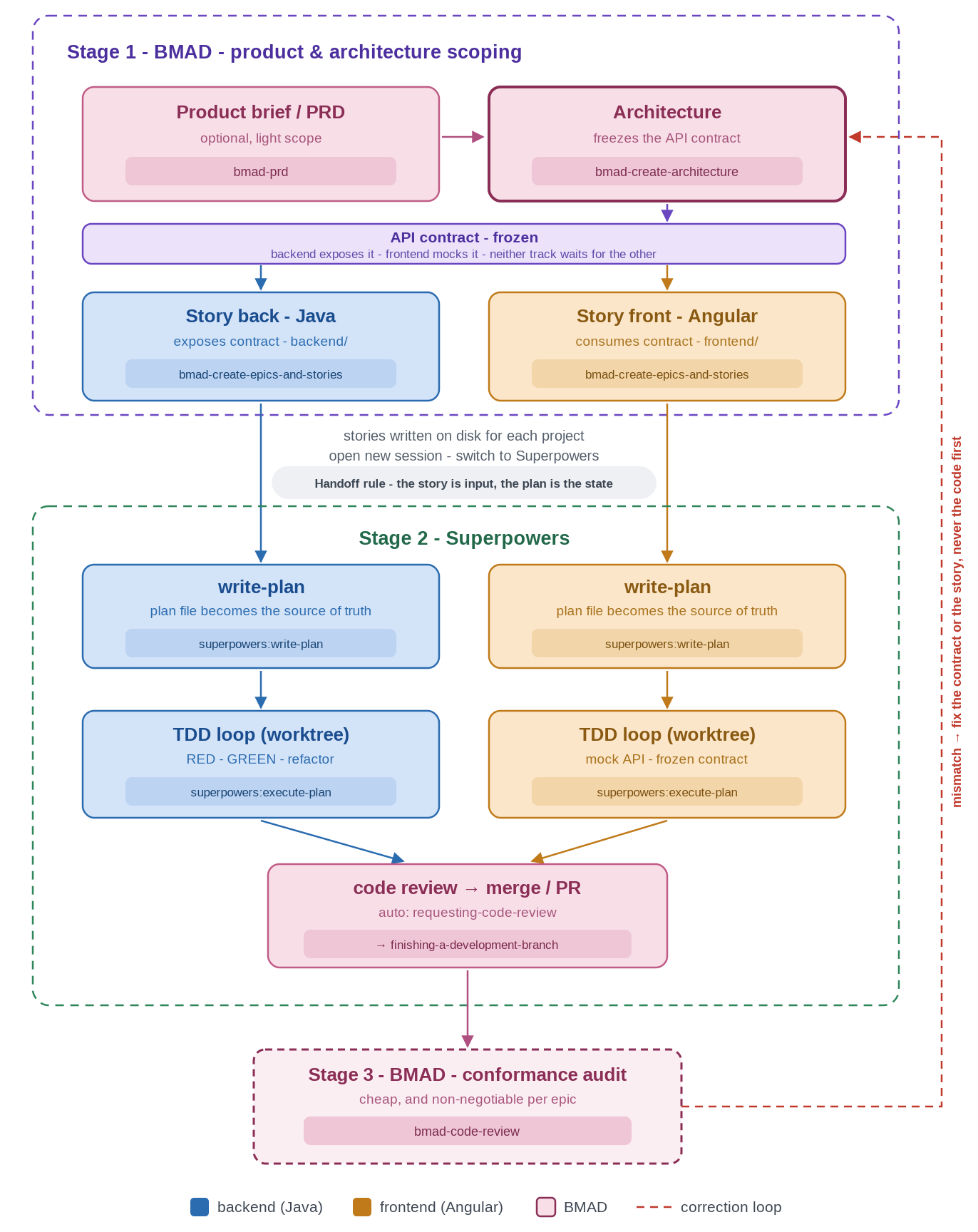
Stage 1 — BMAD scopes the product and the architecture. A light PRD, then the architecture workflow. It ends when the stories exist on disk, one set per repository.
Stage 2 — Superpowers implements. The stories are read from disk. write-plan, then execute-plan inside a git worktree, TDD, then automated code review and the branch is finished.
Stage 3 — BMAD audits conformance. Does the merged code still match the contract and the architecture that Stage 1 froze?
On this feature the whole thing took three working weeks, and I was not alone: a BA and a PO worked with me. It splits into roughly four days for Stage 1, nine for Stage 2, and two for Stage 3.
The box that makes the rest legal
The most important part of that diagram is not a stage, it is the API contract. What matters is not that it never changes, but that it can only change on purpose, through an explicit, visible act.
"Frozen" is the shorthand I use, and it is a slightly dangerous word. It does not mean the contract is correct, and it does not mean it is permanent. It means no story gets to quietly reinterpret it. Changing it is allowed, but loudly, in one place, with both tracks notified.
Once the architecture workflow has frozen the contract, the backend track exposes it and the frontend track mocks it. Neither waits for the other. The two coloured columns are not a drawing convenience: they are two parallel work streams that are only safe because a contract sits above both of them.
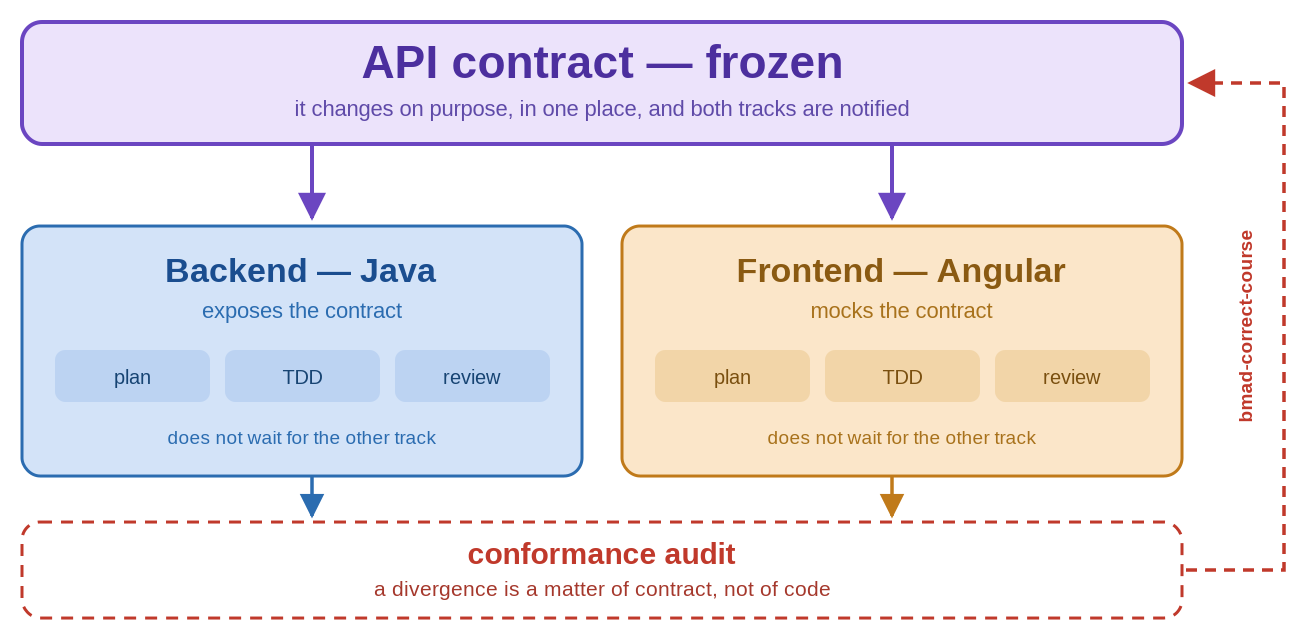
This is the same argument I made in Part 2 about OpenAPI as the source of truth for the API. Here, it does structural work: it is what allows two agents in two repositories to move at the same time without integrating on trust. Freeze the contract and parallelism becomes possible. Leave it soft and every story becomes a negotiation.
And now the honest part, because this is the claim in the article most likely to be wrong in your project. A contract frozen before implementation can be frozen in the wrong shape, and a wrong contract held firmly is worse than no contract at all: both tracks implement faithfully against it, both suites go green, and you get two well-tested halves of a mistake. Green tests on both sides is exactly what a mismatch looks like when the mismatch is upstream of the tests.
That is why the correction loop later in this article is not an optional refinement: it is what makes freezing the contract early survivable.
Epic, story, plan — three different objects
Below the contract sits the work itself, divided into three objects that are easy to confuse. A shorthand I hear often is that epics are the features and stories are the design. That is half right, and the wrong half causes trouble.
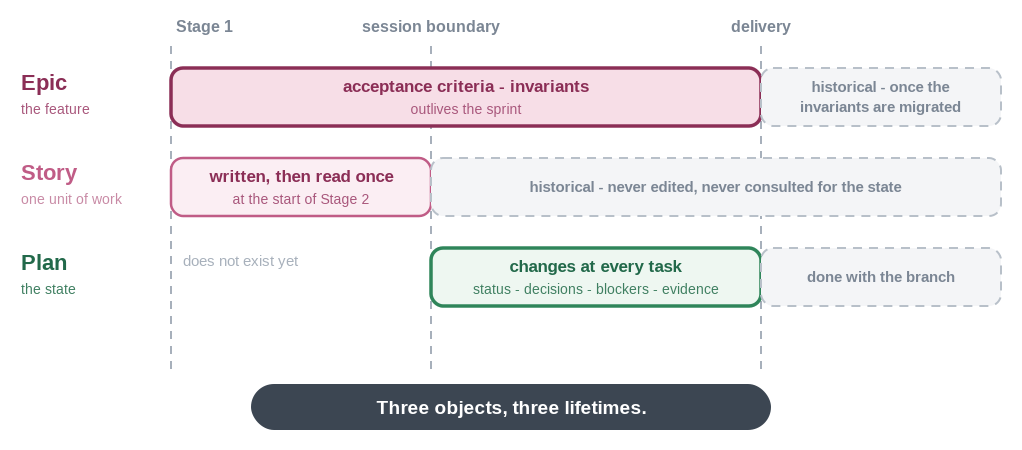
The epic is the feature. A coherent slice of product value, with acceptance criteria that outlive any single commit.
The story is a unit of implementable work, not the design. The design lives in the architecture. What a BMAD story carries is enough context to implement it without re-reading the architecture: the constraints that apply here, the patterns to follow, and the part of the contract it touches. That is why a good story reads like a design document, but it is not one: it is a projection of the design onto one unit of work.
The plan is the state of execution. Status, current task, decisions, blockers, verification commands, expected build state — all kept aligned with the code.
In my example, the feature was one epic and three stories: one for the backend, two for the frontend.
And that is where an agile reader should raise an eyebrow, because splitting a feature into a backend story and a frontend story is normally an anti-pattern. It is horizontal slicing: neither story delivers value on its own, and the integration risk is deferred to the merge.
The frozen contract is what makes it legitimate here. The integration decision has already been made and written down before either story starts. The stories are not postponing a negotiation, they are consuming an agreement.
Split by layer without a contract and you get two components that meet for the first time in a merge request. Most of the time, problems emerge during integration, and the production delivery gets postponed with no clear date.
Three objects, three lifetimes: the epic outlives the sprint, the story is consumed once, the plan changes at every task. The epic becomes historical too, but later than the others and under a condition: when the feature is delivered and its invariants have been migrated into the durable specification.
Where does the epic live?
This is a legitimate question anyone asks when the feature crosses more than one repository, and it has a clean answer.
The epic belongs to the feature. The stories belong to the repositories.
An epic is not backend work or frontend work, it is the feature, and the feature is what the business asked for. So it cannot live inside either repository without one of them silently becoming the owner of product intent. The same is true of the PRD, the architecture, and the contract.
That gives a shared planning space: a small repository of its own, or a folder inside one repository. Either works. What doesn't work is copying the same content in many places.
One epic produces one or many stories per repository, split by what is implementable in one go, not by a wish for symmetry between the two sides.
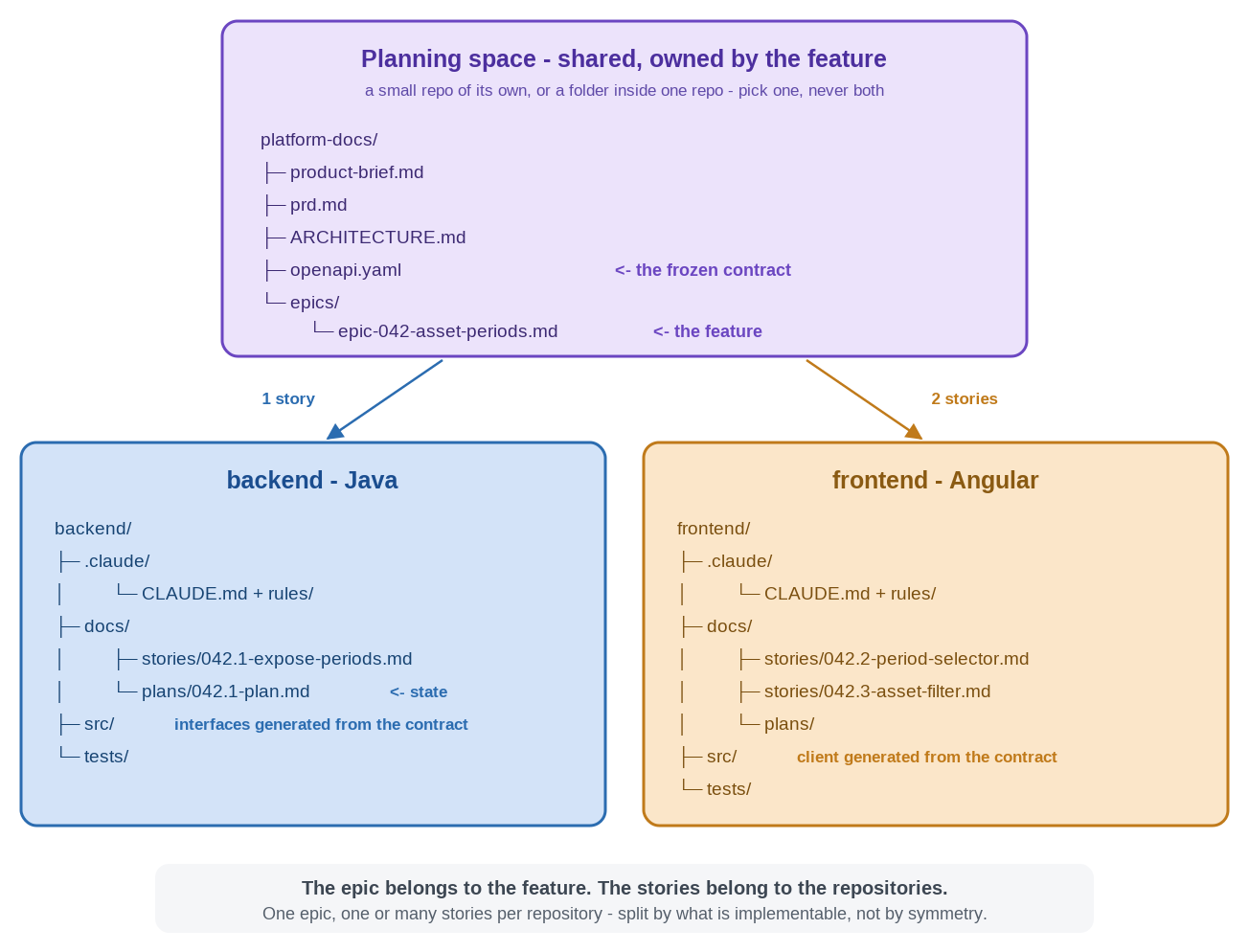
The stories are different. A story is implementable work, and implementable work happens in exactly one repository, next to the rules and the code it touches. That is where the Superpowers session will run, and it needs the story on disk locally.
But my epics live in Jira
They probably do, and that is not a conflict, because "epic" names two different objects.
The epic as a work item lives in the tracker. Status, assignee, dates, dependencies, reporting. It exists so people can run the project. A large feature can hold several of them, and the hierarchy above it depends on your framework rather than on any method.
The epic as a context artifact lives in the repository. It exists so an agent can implement correctly without asking. It is not a status object at all.
They share a name and almost nothing else.
This distinction determines who maintains each artifact, what they put in it, and whether it belongs in the tracker or the repository. The Product Owner or the BA details the epic in the repository artifact (scope, acceptance criteria, constraints, vocabulary, the edge cases someone argued about in a meeting) and leaves the tracker item with what a tracker is for: key, title, status, links, dates.
The tracker holds the status, the repository holds the context, and they are linked by a key, never by a copy. If you paste the epic description into both, you have rebuilt the two-realities problem at the organisational level. So epics/ holds one file per epic, named for its tracker key, and Jira keeps doing what Jira is good at.
The repository file is versioned alongside the code it governs, reviewed in the same pull request, and easy to find when the scope changes; a ticket description is mutable and not tied to any particular code state.
The rule at the session boundary
Between Stage 1 and Stage 2 there is a session change, and that is where I had to make a decision.
At that moment, I had two files claiming to be the state of the work: BMAD's story, and the plan. The Superpowers plan and my plan file from the living-spec method are not two candidates, they are the same file. Superpowers writes the plan; the living-spec method decides what goes in it, which is the state of the current work instead of leaving it in the chat.
I resolved it with one rule:
The story is input. The plan is the state.
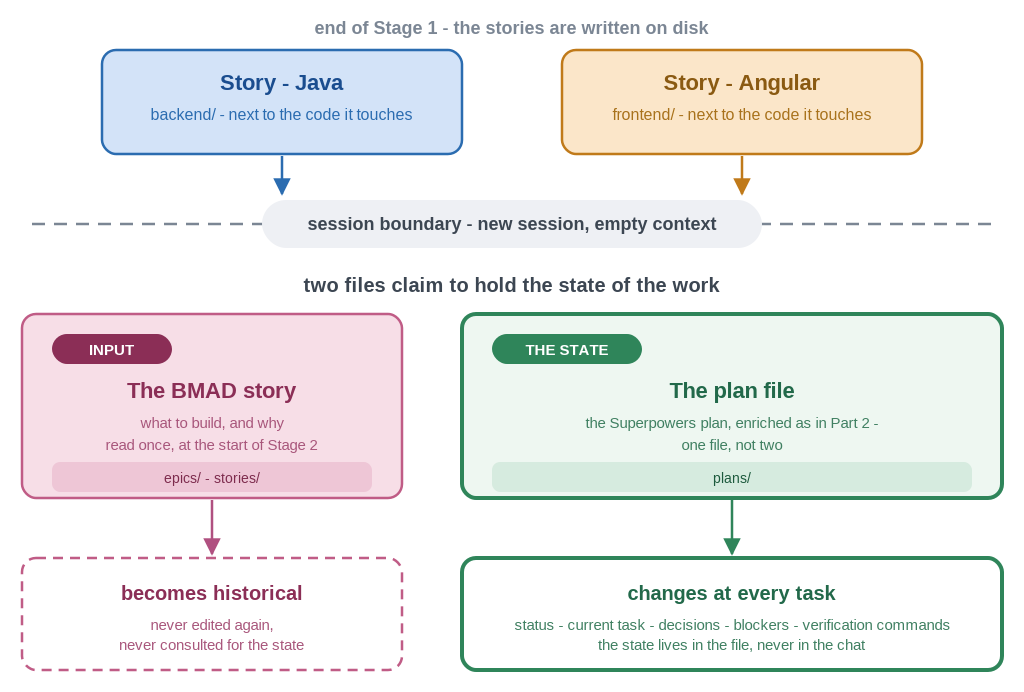
The BMAD story describes what to build and why, similar to what Superpowers proposes with its specs/design files. It is read once, at the start of Stage 2, and then it becomes a historical document. From that point, the plan file carries the current task, decisions, blockers, and verification commands, exactly as in the living-spec method. Superpowers itself makes the same distinction: the specs folder holds the design, while the plans folder holds the execution plans. So in my loop, the BMAD story plays the role of the design input, while the plan remains the living state of execution.
This is not a detail. Only one file can hold the state. Let two of them claim it and they do not average into one truth: they drift apart quietly, and the agent believes whichever one it opened last.
I did not have to test this on purpose, it happened by itself. The plan was written one day and the execution started the day after, or later. More than once I stopped in the middle, at task 3 or task 4, and came back the next day, in a new session, to continue at the same task. Nothing was lost, because the plan file said where I was.
Who holds which role
While building the loop, I also wanted to make one thing explicit: who actually owns each decision.
The artifacts are settled, and so is the boundary between them. What is not settled is the sign-off. Part 2 walked through ten roles across the SDLC.
What follows is not that, but an overview of the few roles that own a step in this particular loop: Product Owner, Architect, Tech Lead, and Developer. The others do not disappear.
UX/UI, QA, Security, Data, Platform, and SRE simply have no tile of their own here, and two of them are worth naming. QA moved inside the TDD cycle and the conformance audit rather than into a step of its own, and the question from Part 2, do these tests prove the right thing, is now part of what the Developer approves in the plan.
The UX/UI Designer works one level below this diagram: the design rules live in the frontend rule files, and the running Angular application is still the maquette.
For the roles that are shown, the claim from Part 2 holds and becomes concrete: the value of each one moves from producing an artifact to judging whether it should exist, whether it expresses the intended solution, and whether there is enough evidence to trust it.
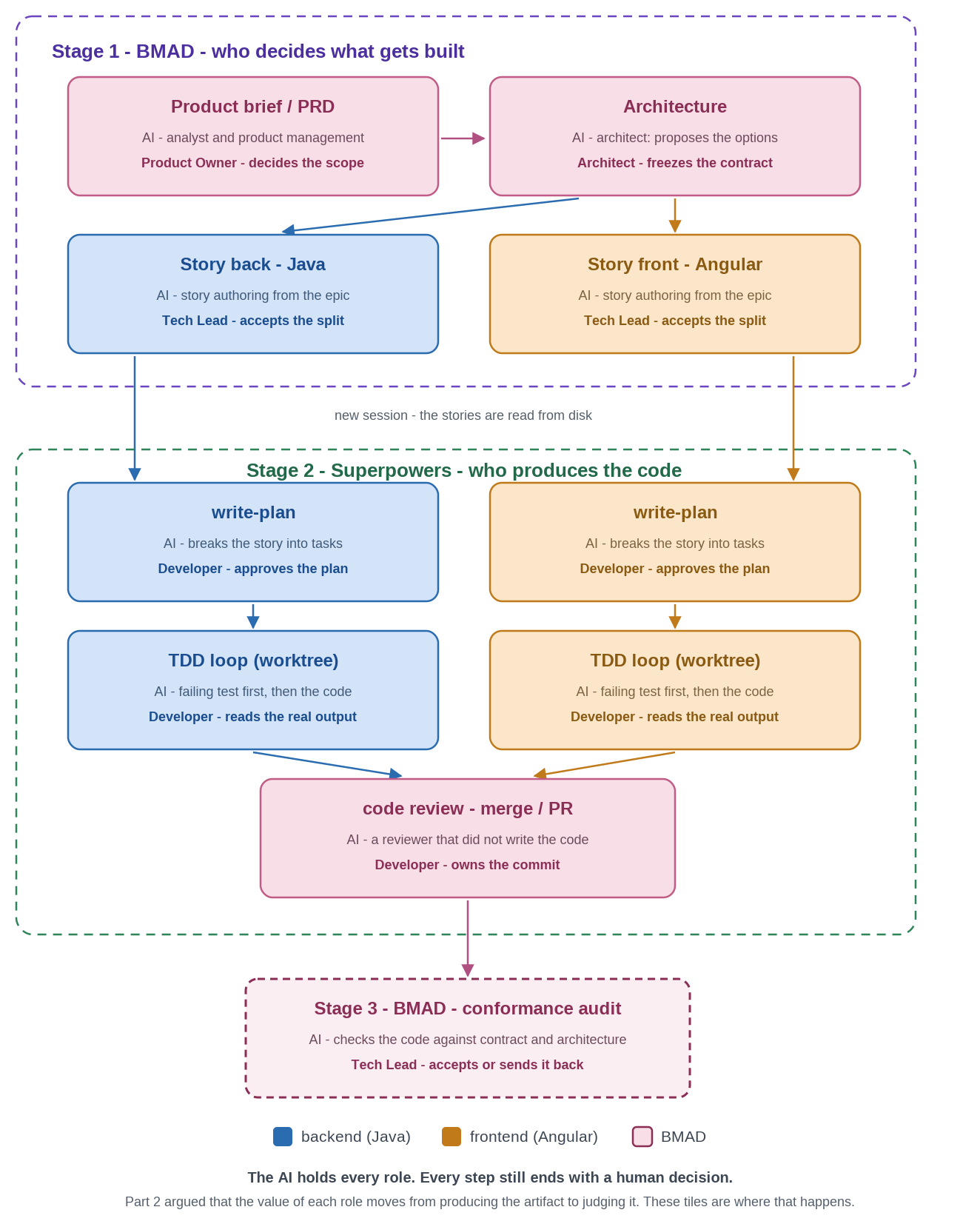
Read the diagram against the role descriptions in Part 2, and the mapping is direct. The Product Owner no longer writes requirements; they decide the scope and make the ambiguity explicit before it becomes code. The Architect no longer draws the architecture; they compare the proposed options and freeze the contract. The Developer no longer types the implementation; they approve the plan and read the real output. The Tech Lead is left with the part that is never automated: judgment.
One mapping is not a straight copy. In Part 2 the Architect verifies conformance continuously, and here the Stage 3 audit is accepted by the Tech Lead. The audit runs across two repositories, so the question is not only whether one service respects the contract, but whether the two generated solutions still fit together. That is the Tech Lead question from Part 2, and it is the same one behind accepting the story split.
A note on the labels: BMAD ships named agent personas, and that line-up moves between versions: v6 folded the separate Scrum Master and QA agents into the Developer agent. So my diagram names roles rather than personas. A role survives an upgrade; a persona name does not, and an article built on persona names would be wrong by the next release.
The AI can hold every role in that diagram. That is the part people find unsettling, and it is not the interesting part.
The interesting part is that every step ends with a human decision, and this is not an option at all.
Part 2 argued that AI made quality cheaper because the mechanical cost of doing the right thing collapsed. If I now demand an approval at seven steps per story, I have simply moved the bottleneck from typing to attention, and attention is a scarce resource. A method that needs a thoughtful human at every step will get a distracted one instead, which is worse than not asking.
So the decisions are not equal, and pretending otherwise is how approval becomes a rubber stamp. The distinction I actually used is reversibility. Approving a plan is cheap to undo: a bad plan costs one rewrite. Freezing the contract, owning the commit, and accepting the conformance verdict are different: they are the points where a mistake propagates into other people's work, and none of the three is delegable, not because the AI would do them badly, but because they are where somebody takes responsibility. An agent can produce the architecture; it cannot be accountable for having chosen it.
Note how consistent that is across my loop: decide the scope, accept the split, approve the plan, read the real output. Not one of those is typing.
Why three stages, and not one
Superpowers alone is already a serious workflow: brainstorming before code, plan writing, red-green-refactor where the test must fail first, systematic debugging, review by a separate agent. If it is that good, why wrap it in BMAD at all?
Because of scope.
Planning scope is not execution scope. Superpowers reasons brilliantly about the task in front of it. It cannot tell you that story 7 will quietly break an authorization rule established in story 2, because story 2 is not in the room. Stage 1 exists to hold the level above the story: the contract, the architecture, the order of the work, the parts of the system a single story cannot see.
A gate is not a persona. BMAD's implementation workflow is a role with instructions. Superpowers' TDD is a gate: the test must fail before the code is written. A persona can be talked out of its discipline by an eager model; a red-green cycle cannot. Stage 2 exists because that is where I want mechanical enforcement rather than good intentions.
In Part 2, one of the rules that survived the whole project was to separate audit from fix. Stage 3 is that rule in tool form. The agent that just wrote the code is not a reviewer of the code.
Those three reasons are also the answer to the question I opened with. What BMAD adds to a living specification is not more specification, but the level above the story: the contract, the order of the work, and a reader of the result who did not write it.
And there is a fourth element, one that never appears on the diagram: the seam between the stages. I gave it a rule earlier (the story is input, the plan is the state) but that rule only settles who holds the state across the seam, not why the seam is worth having.
Planning artifacts are expensive to carry. Dropping them at the handoff is a feature, not a compromise, provided the stories on disk are complete enough to survive the drop. That is what Part 2 demanded of a session, applied to a tool chain: kill the session, clear the context, and see whether a fresh agent can continue from artifacts alone. I never ran that as an experiment. My own working days ran it for me, and the plan file is what made it pass.
Where the two methods collided
The two methods never contradicted each other on paper. They collided in the middle of a session, and the collision looked exactly like good practice.
Stage 2 opened on the backend story. Superpowers did what it is supposed to do: brainstorm before writing anything. And it asked a good question:
- should the server compute the period comparison and return one payload, or return two series and let the client compare them?
That's a fair question, well posed, the kind you want an engineer to ask.
It is also a question Stage 1 had already answered and written into the contract.
Nothing failed. No tool complained. The agent weighed both options, chose the one it judged better, and wrote a coherent plan against it, ready to start with a failing test. Every Superpowers gate was respected. Meanwhile, in the other repository, the frontend track was mocking the parameter that plan had just decided to drop.
Two methods, both behaving correctly, pointing in opposite directions:
Superpowers says explore the design before you build.
BMAD says the contract is frozen — you are consuming an agreement, not negotiating one.
The dangerous part is that you don't notice at plan time. The plan reads well. If I had let it run, both suites would have gone green: two well-tested halves of a mistake I described earlier. I caught it while reading the plan, and only because the contract was a document I could compare against and not an assumption in my head.
So the contract did not stop the drift, it only made the drift visible. That is a smaller promise than it sounds, and it is the one I can defend: freezing the contract does not remove the need to read what the agent decided, it gives you something to compare it against. Both cases in this article were caught that way, by reading. The two tracks are safe because of the contract and the reading together.
So the collision is not tool against tool, it is a scope mismatch. Superpowers reasons about the story in front of it, and it is right to; it simply cannot know that the design question it just raised was decided one level up, in a room it was never in.
The rule that came out of it sits at the same seam as the previous one:
In Stage 2, the agent may brainstorm about how, never about what the contract says. A good idea that contradicts the contract is not an implementation decision, it is a change request.
And it stayed a good idea. It was not discarded: it went back up to Stage 1 through bmad-correct-course, the contract changed on purpose and in one place, and both tracks were told.
Two specifications
BMAD produces a PRD, an architecture document, and stories. My method already has a specification and invariants. Nothing in either tool tells you which one wins. That is the scattered-specification problem from the opening, arriving this time through the front door, wearing the uniform of a respected method.
Both tools offer a design artifact: Superpowers has its specs folder, BMAD has its stories. They describe the same thing, so only one was allowed to exist, and I kept the story. What I dropped is specs/ alone: plans/ stays exactly where it was, and it is still the state of execution. The content of the specification did not disappear; it moved. The invariants and acceptance criteria are stated in the epic, and the invariants are then projected into the stories that touch them.
The reason for keeping the story is where the context already sits: at the end of Stage 1, BMAD is holding the PRD, the architecture, and the epic in one session, so the story is simply recording what was decided minutes earlier. Producing the same document again in Stage 2 would mean rebuilding that context in a fresh session and paying for it with another round of tokens, only to end up with the artifact I already had.
My conclusion: BMAD's artifacts are derived working artifacts; the living specification is durable.
That does not mean the working artifacts are disposable in the careless sense. The valuable decisions in them still have to survive the workflow. The most valuable content in a PRD is not the requirement, it is the alternatives that were rejected and the reason they lost. Part 2 says a decision that lives outside the plan did not happen; the same applies here. If you discard the PRD without preserving the reasoning behind the decision, you keep the conclusion but lose the rationale, and the team will debate the same choice again six months later.
So the rule is: the PRD is no longer authoritative once its decisions have been migrated, and the migration is a step somebody performs, not an intention somebody has.
Acceptance criteria are not invariants
This is the sharpest difference, and it is not a criticism of BMAD, it is a difference of object.
An acceptance criterion says: this feature must do X. It is scoped to the work it describes and expires when that work is delivered.
An invariant says: this must never stop being true, in any story, forever. Every API entry point uses the same authorization rule. An asset belongs to the correct organisational scope. A migration preserves the required relationships.
So the two objects went to two different places, and they follow the same route as the design. Both are stated in the epic, because the epic is the feature. From there the acceptance criteria stay at feature level, while the invariants are projected into the stories that touch them: a story carries the invariants that apply to its own unit of work, exactly as it carries the part of the contract it touches.
That solves the short term, not the long one. An epic outlives a sprint; an invariant outlives the epic. Every API entry point uses the same authorization rule is not a statement about this feature, and the next epic must not have to rediscover it. So an invariant ends where the PRD's rejected alternatives end: migrated into the durable specification, by somebody, as a step. A story-shaped method can carry an invariant down to the code. It cannot be the place the invariant lives.
Acceptance criteria are checked once, invariants are checked forever.
The same gap shows up a second time, at the end of the work rather than the start. BMAD's bmad-retrospective reviews a completed epic against its acceptance criteria and produces a verdict. Superpowers finishes a branch once the review agent is satisfied. My method says: show me the verification command and its real output, plus the expected result, written before the command was run. Three declarations of done, and only the third one is evidence. The other two are opinions about evidence. Writing the expectation first is what makes it evidence: a result read afterwards can always be made to look like a success.
The correction loop
Stage 3 asks whether the code still matches the contract and the architecture. The interesting question is what happens when the answer is no.
Most BMAD diagrams, including the ones in tutorials, draw the flow going one way. But the method itself ships bmad-correct-course for significant mid-sprint changes, and bmad-retrospective for evidence-based review against acceptance criteria.
The return path exists. It is simply the part everyone skips, because a linear diagram makes the pipeline look finished at the last box.
I draw it explicitly, with a direction. A mismatch is first a question about the specification (the story, architecture, or contract) before it is a question about the code.
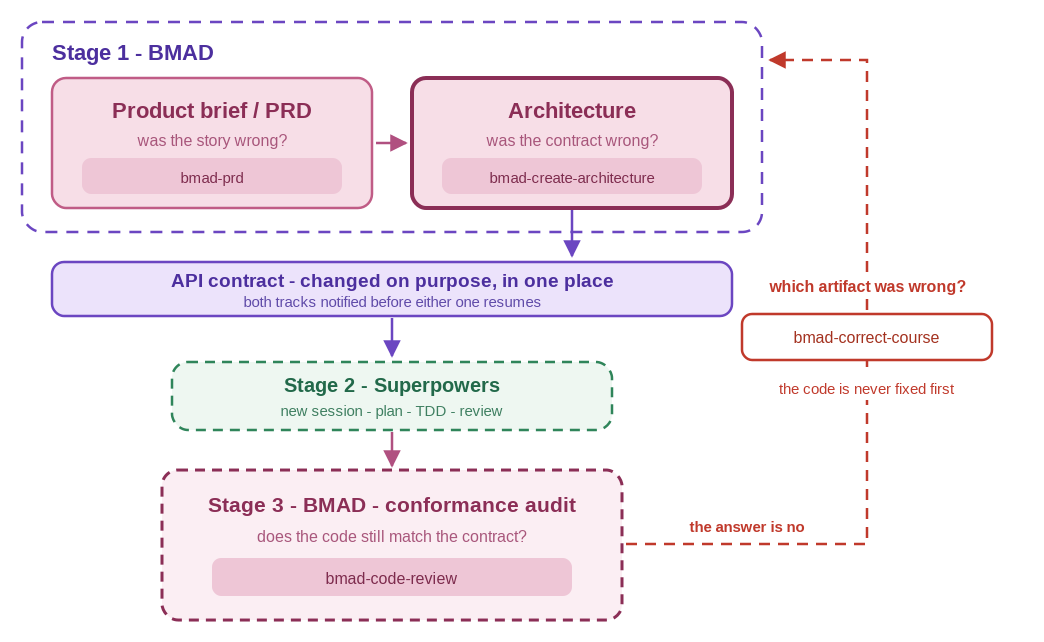
If Stage 3 finds a divergence, the first move is not to patch the implementation, but to ask which upstream artifact is wrong (the story, the architecture, or the contract) and correct that artifact first. The code should then follow the corrected specification. This is the same discipline as Part 2, one level up: do not change the code until you know what in the specification needs to change.
The filters are my clearest example. I wanted the dashboard filters to be the same as the ones on the homepage list of assets, because a user should not have to learn two filter bars in the same product. But the two screens do not show the same data, so the same filter does not always return the same thing. Same filters, different data. That is a decision about the product and the specification, and not the kind of decision a single story should take on its own. So we called bmad-correct-course. The contract itself did not really move, only its description changed. What changed is the specification: the invariants were reinforced and new decisions were added, and both tracks then worked from that. The code came last, which is the whole point of the direction above.
When to use it and when to avoid it
BMAD is powerful and can handle a lot of work, but that doesn’t mean every piece of work benefits from it. It shines when the uncertainty or coordination risk is high enough to justify the overhead.
Greenfield or brownfield
Everything above describes a feature added to a system I already knew. That is the ordinary case, but the first thing to separate is greenfield from brownfield work.
Greenfield is where the method is easiest to justify. There is no existing code to reconcile, so the artifacts BMAD produces are decisions rather than descriptions. Planning pays for itself because it is doing real work: choosing, not documenting.
Brownfield is where the method gets more expensive, because context already exists in the code. BMAD supports established projects, including context discovery that examines the codebase, verifies what it finds, and confirms it with you before recording it.
The trap is thinking you need to describe the whole system first.
You don't have to do that at all. Reverse-engineering an entire codebase into a PRD and architecture document is slow, expensive, and often produces documents that describe rather than decide. Worse, an AI-generated description can be fluent and plausible while still being wrong.
So my rule for existing projects is:
Adopt the method at the boundary of new work. Describe the existing system only as deeply as that work requires.
New features get the full treatment: epic, contract, stories. Existing features get documented only when something touches them. Context discovery should cover the modules the new work actually reaches, not the entire repository.
The old code remains the source of truth about itself, and the specification grows one feature at a time instead of arriving as one 200-page document written up front.
The cost follows from that split. On greenfield, planning cost is proportional to the feature. On brownfield, it is proportional to how much of the existing system you choose to explain first, and that number is under your control.
Beyond that split, the decision comes down to a short list.
Use it when
the work crosses repositories, stacks, teams, or ownership boundaries;
the API contract is the risky part, and freezing it early unlocks parallel work;
the domain is new to you and the expensive mistakes are conceptual, not technical;
the decisions need to remain understandable to people who are not in the room today.
Skip it when
the change is clear and local: BMAD's own guidance is that clear work can enter implementation directly, without the planning artifacts;
you are exploring rather than committing: a spike, prototype, or proof of concept that you expect to throw away does not need the full specification workflow;
the ceremony is larger than the feature: a one-file fix does not need a PRD, and pretending otherwise is how teams learn to hate a method;
the work is repetitive and well understood: a CRUD back-office over a known schema, a simple admin screen, an internal tool, or a batch job where the data model already determines most of the design leaves little for the planning layer to decide;
the change does not alter the feature's shape: bug fixes, copy changes, renames, dependency updates, and missing null checks generally do not require reopening the feature definition or contract.
The distinction is not project size, it is how much of the risk is in deciding what to build. When that risk is near zero, the planning layer has nothing to protect you from.
And the important one, because it is the case that comes up every week: BMAD being installed on the project does not mean every change goes through it. It should not be used for every task. Use it when the work is substantial enough to justify an epic.
The planning layer exists to protect the shape of the system, so it earns its place only when the change can alter that shape. When the answer is clearly no, running it anyway costs time and teaches the team that the method is bureaucracy. The method covers the feature, it does not have to cover every commit.
The real cost is not tokens, it is that you have to learn the workflow set and the handoffs between them before the method starts paying.
If you are not on Claude Code
Stages 1 and 3 are portable. Stage 2 is the replaceable slot.
BMAD is Markdown and YAML, so it works wherever your agent reads files. Superpowers is a Claude Code plugin, so if you work elsewhere, that is the piece you swap: for another plugin, another IDE that enforces the same discipline, or your own commands.
Two things matter when you choose the replacement. It must enforce the test-first cycle rather than suggest it, and it must let a reviewer who did not write the code look at the result. Without those, Stage 3 has to carry weight it was not designed to carry.
One warning, and it is the same one as everywhere else in this article: some tools bring their own planning documents. If yours does, decide which layer owns the story before you start. Running two planners is how you end up with two specifications, scattered again.
We have done this before, and it did not end well
This is the longer version of the argument I promised earlier.
For years, companies built their own frameworks even though good public ones already existed. The reasoning was always the same: our needs are special; we know our business better. For a while, it felt like an advantage. The homemade framework did not fail by breaking, it failed by blocking everything above it.
Now the same reflex is appearing one level higher. Open methods like BMAD exist, yet teams are building their own prompt libraries, rule formats and internal workflows by copying pieces from elsewhere. Same reasons, same trap.
The difference is that this time it moves faster. Models and tools change every day, so maintaining your own method means keeping up with all of those changes yourself. And when a copied rule stops working, its upstream may already have fixed it, but you never get the fix.
The line I would draw is between the engine and the edges as follows:
The engine is the workflows, phases, agent roles and handoff rules. Take that from outside. Let someone else maintain it, find the bugs and keep it current.
The edges are yours: your invariants, business rules, architecture constraints, naming, verification commands and skills. That is where your real specificity belongs.
Before building anything internal, ask:
Who fixes this when it breaks? If the answer is only us, it is a liability.
What does it cost to leave? BMAD is Markdown and YAML, so leaving costs a delete. A custom orchestrator with its own state and habits costs a migration.
The same applies to forking. Customise BMAD until nobody recognises it and you have simply rebuilt the homemade framework, including the same upgrade problem.
That distinction also explains what I publish myself. The living specification is not an engine, it is a way to organise a project: where intent lives, what counts as an invariant, what "done" means, plus practices that survived real work. That is an edge, and every team needs to define its own.
The engine comes from outside. BMAD publishes the workflows, roles, rules and skills, and a community keeps them alive. I am not asking anyone to adopt my framework because I don't have one. I am suggesting a way to organise your project, whichever engine you choose.
What I would tell a team on Monday
Adopt the frozen contract and the session boundary. They cost almost nothing and they are what make parallel tracks safe. I also recommend adopting the loop that lets you revise the contract when it turns out to be wrong.
Adapt the artifacts. Use BMAD's planning workflows to reach decisions, then record those decisions in your specification and let the PRD go. One durable source of truth, several disposable scaffolds.
Skip the full track for small work. Enter implementation directly. A method you apply to everything is a method your team will eventually bypass.
And above all, keep the intent in one shared place. Every lesson in this article is a variation on that one.
AI writes the code. A method decides what gets built. Neither one decides whether it is right.
That still requires an engineer.
Links
The series
Part 1 — AI Writes the Code. So What Is the Engineer's Job Now?
Part 2 — The Living Specification: How I Keep AI-Written Code Correct
The template repository —
CLAUDE.md, rule files, skills, specifications, plans and reusable prompts
Official documentation
Further reading
Claude Code methodologies: Superpowers, BMAD, Spec Kit, OpenSpec — how the four compare
Spec Kit — spec persistence models — the durable specification and its disposable derivations, named
BMAD discussion — backend, frontend and hardware in one method
GitHub discussion — stories when you have more than one repository
Spec-Driven Development: From Code to Contract in the Age of AI Coding Assistants — invariants, pre and postconditions, integration contracts
Let's stay in touch
I share what I learn about AI-assisted engineering, software architecture and databases. If this article made you rethink how you work with a method, follow me on X and connect with me on LinkedIn. I would like to hear how BMAD, or any other method, behaved on your own projects.
About the author
- Stratégie · Transformation · Ingénierie · Architecture
Comments
Join the discussionNo comments yet. Be the first to comment.